
Chapter 1: Hang Tuah and His Companions
Bab 1 — Hang Tuah dan Sahabat-Sahabatnya
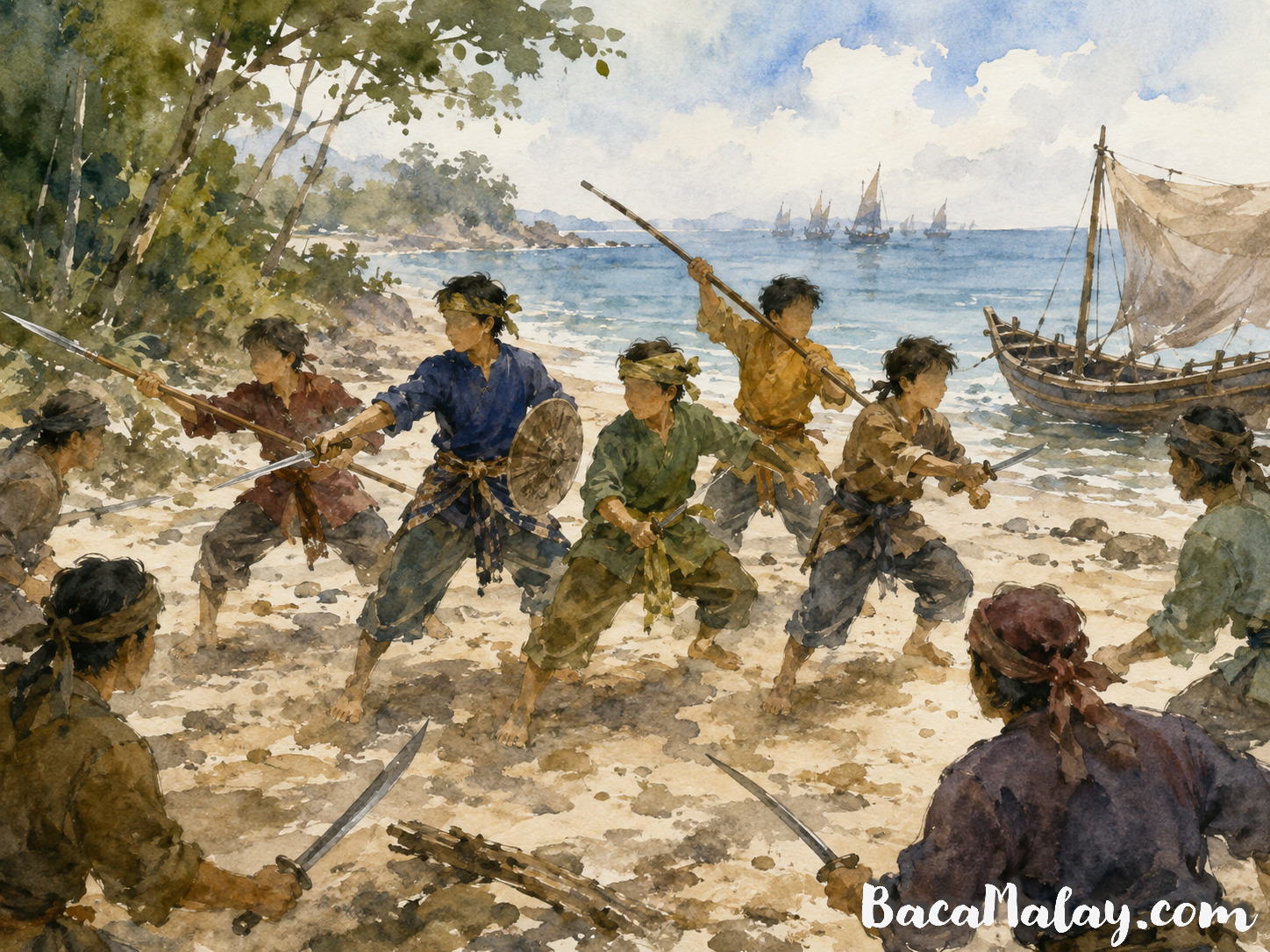
Sebelum terkenal sebagai pahlawan Melaka dan bergelar Laksamana, Hang Tuah menghabiskan masa mudanya di Bintan. Ayahnya bernama Hang Mahmud, manakala ibunya Dang Merdu Wati. Keluarganya berpindah ke Bintan ketika dia masih kecil, dan di situlah bapanya membuka sebuah kedai berhampiran kediaman Bendahara Paduka Raja.
Sejak kecil, Hang Tuah sudah biasa membantu keluarganya. Kayu api dibelahnya untuk meringankan beban keluarga. Pada masa lapang, dia kadangkala pergi menghadap Bendahara. Di situlah dia mula mengenali adab istiadat istana: cara bertutur dengan sopan, cara menghormati orang yang lebih tinggi kedudukannya dan cara membawa diri di hadapan pembesar.
Ketika berumur kira-kira sepuluh tahun, Hang Tuah bersahabat rapat dengan empat orang rakan sebaya — Hang Jebat, Hang Kasturi, Hang Lekir dan Hang Lekiu. Lima sahabat itu hampir tidak pernah berpisah bagai isi dengan kuku; ke mana seorang pergi, ke situ jugalah yang lain mengikut. Mereka makan sehidang, bermain dan menghabiskan banyak masa bersama. Begitu akrab hubungan mereka sehingga hikayat menggambarkan kelima-limanya seperti adik-beradik, bukan sekadar sahabat sepermainan.
Pada suatu hari, Hang Tuah mengajak keempat-empat sahabatnya belayar dan merantau bersama. Mereka pun bersetuju. Dengan sebuah perahu lading milik bapanya, mereka memulakan pelayaran. Ibu bapa masing-masing menyediakan bekalan, sementara mereka sendiri bersiap dengan senjata untuk berjaga-jaga sepanjang perjalanan.
Belum jauh mereka belayar, kelihatan tiga buah perahu lain menuju ke arah mereka. Hang Tuah segera mengesyaki perahu-perahu itu membawa musuh. Mereka hanya berlima, sedangkan pihak lawan datang dengan tiga buah perahu. Namun mereka tidak terus melarikan diri. Hang Tuah mencadangkan supaya mereka menuju ke sebuah pulau berdekatan dan melawan di darat, kerana di situlah mereka lebih mudah mempertahankan diri.
Keempat-empat sahabatnya bersetuju tanpa berlengah. Sebaik sahaja pihak lawan mengejar mereka hingga ke pantai, kelima-limanya bersiap menghadapi serangan. Mereka bertempur bahu-membahu sehingga musuh akhirnya dapat ditewaskan. Kemenangan itu bukan semata-mata hasil keberanian; sejak usia muda, mereka sudah belajar menilai keadaan, bekerjasama dan saling mempercayai dalam keadaan genting.
Sekembalinya ke Bintan, mereka terus menimba ilmu, termasuk berguru dengan seorang pertapa bernama Adi Putera. Ilmu yang dituntut bukan sekadar ilmu mempertahankan diri. Seorang bakal hulubalang tidak hanya memerlukan kekuatan; keberanian perlu disertai kebijaksanaan dan pertimbangan sebelum bertindak.
Nama Hang Tuah mula menjadi sebutan selepas dia seorang diri berdepan dengan seorang pengamuk di pasar. Namun peristiwa yang benar-benar mengubah nasib kelima-lima sahabat itu berlaku tidak lama kemudian.
Pada suatu hari, empat orang pengamuk bersenjata menyerbu kawasan berhampiran kediaman Bendahara. Orang ramai bertempiaran menyelamatkan diri. Ketika Bendahara melalui pasar, para pengiring yang bersamanya turut melarikan diri sebaik sahaja melihat para pengamuk menuju ke arahnya.
Hang Tuah dan empat sahabatnya tidak berganjak. Tatkala orang lain memilih untuk menyelamatkan diri, kelima-limanya tampil ke hadapan dan berdiri antara Bendahara dan para penyerang. Pertarungan tercetus, dan akhirnya mereka berjaya menewaskan keempat-empat pengamuk itu.
Bendahara kagum akan keberanian mereka. Dia juga mengenali keluarga kelima-lima anak muda itu. Dibawanya mereka ke rumahnya dan dijamunya. Sejak itu, kelima-limanya berada di bawah naungannya.
Berita tentang kejadian itu akhirnya sampai ke pengetahuan Raja. Baginda memanggil Bendahara menghadap kerana mahu melihat sendiri lima orang anak muda yang telah mempertahankan Bendahara ketika para pengiring lain melarikan diri.
Tidak lama kemudian, Hang Tuah, Hang Jebat, Hang Kasturi, Hang Lekir dan Hang Lekiu dibawa menghadap Raja di balairung. Baginda berkenan menerima mereka untuk berkhidmat di istana lalu menganugerahkan persalinan kepada masing-masing sebagai tanda penghargaan.
Sejak hari itu, kehidupan lima sahabat itu berubah. Mereka mula berkhidmat di istana bersama-sama.
Adapun ketika itu, tiada siapa yang dapat menduga bagaimana persahabatan Hang Tuah dan Hang Jebat akan diuji suatu hari nanti — bukan lagi oleh musuh di laut atau pengamuk di pasar, tetapi oleh dugaan yang jauh lebih berat.
Cultural Notes / Catatan Budaya
Bintan Before Melaka
In the Hikayat Hang Tuah tradition followed in this series, the early adventures of Hang Tuah and his four companions take place in Bintan. The ruler and his court move to Melaka later in the story.
Royal Court Titles and Offices
Bendahara, Laksamana and hulubalang were titles or positions associated with traditional Malay royal courts. Their duties and status do not correspond exactly to modern government or military positions. Bendahara is roughly comparable to a chief minister, while Laksamana is often translated as “admiral”; hulubalang refers to a warrior or military commander in royal service. Baginda is a respectful third-person royal pronoun. Depending on context, it may be rendered in English as he or she, the Raja, or His/Her Majesty rather than as a fixed title. Menghadap means to appear before a ruler or other high-ranking person, and berkenan is a court-register verb used for a ruler’s consent, approval or willingness.
Perahu lading
A perahu lading is a small traditional dugout boat, made by hollowing out a piece of timber. The term appears in the Hikayat Hang Tuah account of the five friends’ early voyage.
Amuk
Amuk refers to a violent, uncontrolled attack or rampage. A person doing this may be called a pengamuk. The English expression “run amok” comes from the Malay word amuk.
Persalinan
In a royal-court context, persalinan could refer to clothing presented by a ruler as a mark of honour, favour or recognition. In this chapter, the gift shows that the five young men have been formally recognised by the Raja.
Merantau
Merantau refers to leaving one’s home area to travel or live elsewhere, often to gain experience, seek opportunity or become more independent. In this chapter, Hang Tuah and his friends set out beyond home together; the word carries a broader sense than simply “travel.”
Bagai isi dengan kuku
Bagai isi dengan kuku literally means “like flesh and fingernail.” It is a Malay peribahasa used to describe people who are extremely close and difficult to separate. In this chapter, it reflects the strong bond between Hang Tuah and his four companions. A roughly comparable English expression is “joined at the hip.”
Key Vocabulary
English Translation
Before he became known as a warrior of Melaka and held the title of Laksamana, Hang Tuah spent his early years in Bintan. His father was Hang Mahmud and his mother was Dang Merdu Wati. His family moved to Bintan when he was still young, and it was there that his father opened a shop near the residence of the Bendahara Paduka Raja.
From an early age, Hang Tuah was accustomed to helping his family. He chopped firewood to ease the family’s burden. In his free time, he would sometimes go to see the Bendahara. There he began to learn the etiquette of the court: how to speak politely, show respect to people of higher rank and conduct himself properly in the presence of senior officials.
At around the age of ten, Hang Tuah became close friends with four boys his age — Hang Jebat, Hang Kasturi, Hang Lekir and Hang Lekiu. The five were almost inseparable; wherever one went, the others followed. They shared meals, played and spent much of their time together. Their bond was so close that the hikayat portrays them as being like siblings rather than merely childhood companions.
One day, Hang Tuah invited his four friends to sail away and travel beyond home together. They agreed. Using a perahu lading belonging to his father, they set out on their journey. Their parents prepared provisions, while the boys themselves carried weapons as a precaution along the way.
They had not sailed far when three other boats appeared, heading towards them. Hang Tuah immediately suspected that they carried enemies. There were only five of them, while their opponents approached in three boats. Yet they did not immediately flee. Hang Tuah suggested heading towards a nearby island and fighting on land, where they would be better able to defend themselves.
His four companions agreed without hesitation. As soon as their opponents pursued them to the shore, all five prepared to face the attack. They fought side by side until their enemies were finally defeated. Their victory came from more than courage alone; even at a young age, they had learned to assess the situation, work together and trust one another in moments of danger.
After returning to Bintan, they continued to seek knowledge, including studying under a hermit named Adi Putera. What they learned went beyond self-defence. A future hulubalang needed more than physical strength; courage had to be accompanied by wisdom and judgement before action was taken.
Hang Tuah’s name began to attract attention after he faced a man running amok in the marketplace on his own. However, the event that truly changed the fortunes of all five friends happened soon afterwards.
One day, four armed men ran amok near the Bendahara’s residence. People scattered to save themselves. As the Bendahara passed through the marketplace, even the attendants accompanying him fled as soon as they saw the attackers heading towards him.
Hang Tuah and his four companions stood their ground. While others chose to save themselves, the five stepped forward and placed themselves between the Bendahara and the attackers. A fight broke out, and in the end they succeeded in defeating all four men.
The Bendahara was impressed by their courage. He also knew the families of the five young men. He took them to his home and gave them food. From then on, all five were under his protection.
News of the incident eventually reached the Raja. He summoned the Bendahara because he wanted to see for himself the five young men who had defended the Bendahara when the other attendants fled.
Before long, Hang Tuah, Hang Jebat, Hang Kasturi, Hang Lekir and Hang Lekiu were brought before the Raja in the balairung. The Raja accepted them into service at the court and presented each of them with persalinan as a mark of appreciation.
From that day onwards, the lives of the five friends changed. They began serving at the court together.
At that time, however, no one could have foreseen how the friendship between Hang Tuah and Hang Jebat would one day be tested — no longer by enemies at sea or men running amok in the marketplace, but by a far greater trial.
Your saved and completed readings are stored in this browser. They will not sync to another device until reader accounts are available. View Saved Readings